Search This Blog

Thursday, November 11, 2010

I am Quoted By Bloomberg News

Another Reason Why Inflation Isn't Coming Courtesy of Milton Friedman

MIilton Friendman is best known (among economists not political pundits) for his quantity theory of money i,e, monetarism:


from Wikipedia
he equation of exchange can be used to form a rudimentary version of the quantity theory of the effect of monetary growth on inflation.
P=\frac{M\cdot V}{Q}.
If V and Q were constant, then:
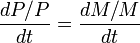
\frac{d P}{P}= \frac{d M}{M}
and thus
\frac{d P/P}{d t}=\frac{d M/M}{d t}
where
t is time.

which says that the inflation rate equals the monetary growth rate plus the growth rate of the velocity of money minus the growth rate of real expenditure. If one makes the quantity theory assumptions that, at least in the long run, (i) the monetary growth rate is controlled by the central bank, (ii) the growth rate of velocity is purely determined by the evolution of payments mechanisms, and (iii) the growth rate of real expenditure is determined by the rate of technological progress plus the rate of labor force growth, then while the inflation rate need not equal the monetary growth rate, an x percentage point rise in the monetary growth rate will result in an x percentage point rise in the inflation rate.

Looking at thiese charts(from the great website  it seems clear to me Friedman would not be looking at the prospect of future inflation. There is no velocity to money. Unfortunately it also may mean that the economiy is in a " liquidity trap" and the fed's easing will do little to help the economy (which doesnt mean  it's not worth a try)

 Here(immediately below)  is the "V" from the equation

and here (immediately above) is the "M"


here is money supply and inflation expectations via the tips/conventional bond spread (excuse the scan from the FT). . Note that M2 (money in circulation) hasn't changed even as the monetary base M1 increased. The Fed can only move M1 M2 reflects whether or not the banks sit on the money or lend it out creating a multiplier of wages and consumer spending. M2 creates spending an potentially inflation. Money sitting in the vault and not circulating can't create inflation (or jobs).


a nice article on the deflation vs inflation argument is here

Bubble Bubble....?


LA Times page 1 Nov 9

Rumblings of inflation grow louder

Commodity prices are rising — driven by higher consumption, bad weather and investor demand — and Americans are starting to feel it in their pocketbooks.

WALL STREET JOURNAL PG 1 November 9

Commodity Prices Surge

Gold, Cotton Touch New Highs as Fed Stimulus, Chinese Growth Drive Demand

BoA Merrill Lynch launches UCITS-qualifying commodities funds


4 Nov 2010
Bank of America Merrill Lynch is launching it Commodity Alpha & Beta family of UCITS III funds, namely the MLCX Commodity Enhanced Beta Fund; the MLCX Agriculture Optimal Crop Fund; and the MLCX Commodity Alpha Fund.

DFA Plans to Roll Out a Commodity Fund

Investor demand trumps DFA's skepticism about commodities as diversifier and inflation hedge

Article |


Dimensional Fund Advisors (DFA) is expected to roll out the DFA Commodity Strategy by year-end, according to a report by Morningstar Advisor on Monday, August 23. Morningstar noted that DFA had registered with the Securities and Exchange to launch the new product on August 16....
Morningstar suggested that in offering the new fund, DFA acceded to the wishes of its large clients. But it had to put aside its skepticism about the long-term usefulness of commodities as a portfolio diversifier and inflation hedge. DFA, Morningstar said, bases most of its fund offerings on academic research demonstrating that small-cap value stocks tend to outperform over the long term.


Kenneth French on the DFA website:

KRF: No, my views have not changed—at least on this topic. Here's the thrust of my 2004 presentation....As a result, investors who use commodity funds to hedge inflation almost certainly increase the risk of their portfolios. Six years after my presentation, I still think these points are correct. Commodity funds are probably a good investment for some investors, but not for the reasons many of their advocates suggest.

glenn beck,com: (transcript form november 9: radio program 10 million listerners


GLENN: No, no. I will tell you this. We have had our financial advisors, the guys who are stat-related guys, they are not politicians. They are more like the David Walkers of the world, you know, that they're just, all they do is look at stats. All they do is look at stats. And all of them are saying around the corner. All of them are saying starting in January you're going to see real price inflation. One of our experts, and I don't name them because they advise us off the air. They're not, they're just -- you know, quite honestly I think many of them don't want to be associated with me because they don't want all the trouble associated..., an This is what they do for a living. And one of them said by next year a quarter of this nation will not be able to afford food. A quarter of the nation will not be able to afford food. I have to tell you, I'm never, ever right on timing. I have -- I'm not giving you my projection of timing. I'm telling you that there are these experts that say this. Is this true? I have no idea. I will tell you that historically speaking printing money leads to unbelievable inflation and gigantic interest rates. That's what happens. Period. So is it going to happen? At some point, yes. When? I don't know. I just ask you to please prepare.

Now, people have been writing me and saying, Glenn, what do we do? How do we prepare? ... And if you can save money and buy extra food and put it on the shelf, do so. If you can spend the extra money on having some food storage, if you are somebody who, you know, you've got grandkids now and you can't get the kids to listen to you and you have some extra money, buy it and put it on the shelf for them. ...


Experts are now telling me that it's happening next year. I don't know. I just know that prices of commodities have gone through the roof. I know that when I started telling you about gold, it was $700. When they were making fun of me and telling me that I was going to destroy people's lives because they were all going to go broke and you were just a hapless dupe when you were buying it at $1100 an ounce, today it is over $1400 an ounce. Could be worth $300 tomorrow. I don't know. But please look at the direction of --


PAT: I like how you say that, though, for the reverse psychology element. You tell them that so they will go ahead and buy it...


GLENN: Shhh.

PAT: And then when it does drop --

GLENN: Shhh.


the following appears at the top of the site:


Re: my post on inflation and unemployment

David Leonhardt in the NYT

Tuesday, November 9, 2010

Yet Another Reason Not To Own Actively Managed Funds : Bonds or Stocks

so much for knowing much about a fund from its label,,,and so much for "style purity"

Wsj reports:

....Even managers of some high-yield mutual funds are reducing their exposure. The John Hancock High Yield Fund has increased the stock allocation of its $1.1 billion portfolio to its legal maximum of 20%, up from 13% a year ago

This "Top Guru" Admits His Forecasts Are Only a Bit Better Than A Coin Flip

Mohammed el Erian of Pimco is never shy about speaking publicly with his market forecasts. Yet Investment News reports:
...(there has been a ) 16% advance in the S&P 500 since July 2, according to data compiled by Bloomberg. The index surged 12% in September and October, the biggest rally for those months since 1998.

Pacific Investment Management Co. LLC, which oversees the world's biggest bond mutual fund, said in May 2009 that rising government deficits and regulation would hold gains in equities and bonds below historical averages. Mohamed El-Erian, Pimco's co-chief investment officer, said recently that his projection has a 55% chance of coming true.

don't like that forecast ? here's another from the same article:

“Of the leading economic indicators, one of the most important is the stock market,” said Mr. Birinyi, whose Birinyi Associates Inc. advised clients to buy stocks in March 2009 when the S&P 500 began rising from a 12-year low. “The market's saying something, and it's saying the economy is going to be surprising on the upside

Monday, November 8, 2010

Inflation on The Way ? Not Till Unemployment Falls by 50% ....anId unfortunately that is not in the cards for the forseeable future


 see above (I got this from Krugman's blog... you can argue policy but numbers dont lie)

You dont get inflation with no increase in wages(and note the average hourly earnings number here is not inflation adjusted) as you can see in the attached chart....and with 10%+ undemployment (more like 16% + if you add in discouraged and underemployed) we are far from a situtation where employers have to raise wages to attract/retain workers. That and the extremely low velocity of money makes high levels of inflation an unlikely consequence of QE 2. Unemployment would have to drop by at least half before one could anticipate any significant wage pressure and absent the increases in labor costs the inflation risks are low as the chart shows.

More later on fed policy but for now let's observe that this prescription from Fed Governor Warsh in today's WSJ for policies to get the economy out of the doldrums:

Pro-growth policies include reform of the tax code to make it simpler, more transparent and more conducive to long-term investment. These policies also include real regulatory reform so that firms—financial and otherwise—know the rules, and then succeed or fail. Regulators should be hostile to rent-seeking by the established, and hospitable to the companies whose names we do not know. Finally, the creep of trade protectionism is anathema to pro-growth policies. The U.S. should signal to the world that it is ready to resume leadership on trade.


is like prescribing a garden hose to put out a forest fire.

Despite all the talking heads screaming hyperinflation ( I have one in my ear right now on CNBC) and buying gold I dont think my view is actually in the minority. In fact a forecast of moderate inflation is exactly what is being shown in the treasury bond market:

Here are the market yields in the treasury market where one can take a position directly on future inflation :
                                             
                                               5 year             10 year       20 year

conventional treasuries             1.17               2.66              3.66
tips(infl protected bond)          -.34                 .49                1.18

implied inflation forecast           .83                  2.17              2.48   


as the economist writes in the buttonwood column this week:(the graph appears there as well) You might also find it interesting to compare the grey line in this chart which shows market inflation expectation with the chart at the top of the page that shows actual inflation.

If you compare the yield on conventional bonds with the yield on the index-linked Treasury bond that matures in 2028, the result is an implied inflation rate of 2.4%. That hardly sounds like the Weimar Republic.
Despite all the talking heads screaming hyperinflation ( I have one in my ear right now on CNBC) and buying gold I dont think my view is actually in the minority. In fact a forecast of moderate inflation is exactly what is being shown in the treasury bond market:


Here are the market yields in the treasury market where one can take a position directly on future inflation :
                                             
                                               5 year             10 year       20 year


conventional treasuries             1.17               2.66              3.66
tips(infl protected bond)          -.34                 .49                1.18


implied inflation forecast           .83                  2.17              2.48   


as the economist writes in the buttonwood column this week:(the graph appears there as well) You might also find it interesting to compare the grey line in this chart which shows market inflation expectation with the chart at the top of the page that shows actual inflation.


If you compare the yield on conventional bonds with the yield on the index-linked Treasury bond that matures in 2028, the result is an implied inflation rate of 2.4%. That hardly sounds like the Weimar Republic.


as for all those folk running into gold including  $ billions  from retail investors many taking their advice form screamers on tv and radio ?  The economist column observes:

So why is gold, a classic anti-inflation hedge, still doing so well? The answer to this enduring puzzle may lie in the level of real interest rates. As Chris Watling of Longview Economics points out, gold’s last great bull run was in the 1970s, when real yields were negative. Positive real rates in the 1980s and 1990s had bullion trading sideways for 20 years. In a world of negative yields, owning gold has no opportunity cost.
To follow the logic through: if/when inflation goes up investors will demand higher real yields in the bond market to compensate themselves for the nascent inflation. As real interest rates adjust to take account of this the opportunity cost of owning gold will go up and gold will at a minimum cease to go up. Given the massive flows into gold including leveraged plays I would say "cease to go up" would be a massive understatement. In other words should inflation actually emerge gold  would be exactly the wrong position. Even worse would be a position in long term nominatl bonds established at current levels. Higher actual inflation could likely be bad for both bonds and for gold.

The massive flows into bonds and gold strike me as classic cases of  retail "dumb money" with retail investors invariably buying high and selling low. An excellent academic paper on the evidence of the "dumb money" phenomenon among investors in US stock mutual funds can be found here


I put that into the category of "dumb money" (check this great academic article on the phenomenon of retail investors as "dumb money")


one last observation...as anyone who questions gold knows one prediction always comes true....the gold bugs will soon inhabit the comments section here.