Search This Blog

Friday, October 22, 2010

This Makes Sense to Me


from the NYT

A Basket of Assets in One Investment


AS investment vehicles, exchange-traded funds seem like a perfect fit for retirement portfolios.
The funds, known as E.T.F.’s, are generally relatively low cost and easy to understand. Listed and traded openly on exchanges, E.T.F.’s are baskets that invest in assets as various as global stocks and gold.
Yet picking the right E.T.F. is crucial. Far too many E.T.F.’s are overmarketed and some of the complex funds are loaded with nuances that most investors do not understand. E.T.F.’s can pose an almost irresistible, but risky, temptation to limit your bets to a single industry sector, country or commodity.
This is a particularly good time to invest in E.T.F.’s because major fund managers and vendors are battling one another to win customers by lowering costs. Brokerage commissions and internal fund management “expense ratios” are the major costs of owning E.T.F.’s. By taking advantage of this commission war, investors can increase the net returns on retirement funds....
With more than 1,000 funds to choose from in a $1 trillion industry, which E.T.F.’s do you add to your portfolio? You can start with the simple principle of diversification. Do you have funds that cover the entire United States stock and bond markets? How about international stocks and bonds?
It is also prudent to consider which risks you want to insulate your retirement portfolio from: market downturns, inflation, currency fluctuation and losing out on opportunities abroad, for example.....
Beware, too, of advisers who say they can beat the market with portfolios of E.T.F.’s.
Here I think the writer is oversimplifying a bit  or is at least unclear . No adviser should say he can beat the indices that are tied to the underlying etfs. Of course it is possible that a diversified portfolio  composed of etfs  tied to indices other than the s+p 500  such as the one recommended  in the article (see above in bold ). Could outperform (or underperform) the s=p 500 . And such a portfolio certainly offers more diversification and could  have a different risk/return profile. The  the s+p 500 which is a large cap US stock index in fact it doesnt represent  'the market" in fact it is not a very good proxy for the entire US stock market (unlike a total stock market index represented by an etf such as vanguard's VTI)
While you can always construct a portfolio on your own, it makes sense to consult a certified financial planner or registered investment adviser to see what your portfolio needs — and does not need — before you buy these vehicles. An investment policy statement outlining your objectives is essential. Duplicating what you already have makes no sense. (of course i agree with that one)

Structured Products for Individual Investors :Stay Away

In my earlier life on the institutional side of the financial world I specialized in marketing "structured products' to corporations and institutional investors. I can tell you that our department was extremely profitable. Why ? because the complex structure of these instruments made it difficult for most of the buyers to figure out what the underlying components of the product were hence the spread (markup) of the product were far larger than those of plain vanilla products. In structured products unlike those traded on exchanges there is no transparency of pricing. Furthermore it is near impossible to know the value of the structured product over the life of the instrument. There is also no liquidity in most cases as the investor cannot sell the option prior to expiration.

 To give one example a "structured product" which combined a floor on the loss on an investment but limited the upside potential was relatively easily constructed combining a put purchase and a sold call option. In fact the worst thing that could happen for our structured product group was when some of the structured products began to be traded on exchanges with transparency and liquidity for trading...why ? that meant the end of the massive profit opportunities. Of course most of these new markets were accesible only to large institutional investors.

With many of the profit opportunities no longer available in the relatively simple structured products, financial institutions moved on to market them to individual investors who do not have access to these institutional markets. Furthermore these structured products, unlike products traded on an exchange carry the credit risk of the issuer.

The NYT had an article on such structured products today my bolds and comments in blue


October 20, 2010
An Investment for the Experienced

By JOHN F. WASIK

DEPENDING on whom you talk to, structured products are either clever ways of hedging specific portfolio risks or another demon from Wall Street.
As vehicles that use derivatives to protect or enhance an underlying stock, bond or index, structured products are sold by nearly every major bank and brokerage house — and more than $34 billion of them were sold in the United States in 2009.
Yet they are not for investors who don’t fully understand them, because they are riddled with complexity, are mostly opaque and have lost money for investors in the past. 
“These are complicated investments, and people should know what they’re buying,” said Tom Balcom, a fee-only adviser with Ibis Wealth Management in Boca Raton, Fla. He said he had “yet to put more than 35 percent of a client’s portfolio in structured products,” adding, “If you don’t understand what these products are, stay away from them.”
Sean O’Toole, 43, who owns and operates an event-marketing agency in Fort Lauderdale, Fla., worked with Mr. Balcom to add structured products to his portfolio.
seems Mr. Balcom is ok with his clients buying structured products for less than 35% of their portfolios 
“I’m not betting the farm,” Mr. O’Toole said. “I like diversification. I’d rather be over-conservative if we see another double dip.”
An ultracautious investor concerned about the prospect of another huge stock market decline, Mr. O’Toole has two-thirds of his portfolio in cash and one-third managed by Ibis in structured products like buffered return enhanced notes, which put a cap on the potential gain in return for protection against a market decline. He pays no commission for the vehicles and a 1 percent annual asset management fee to Mr. Balcom.(of course the large markups on these products is not visible to the investor)
Before Mr. O’Toole bought structured products, he had experience with options strategies, an essential prerequisite for anyone interested in structured products.
He should have kept to those liquid transparent options imo. 
While structured products are not household names, they are hot sellers, and sales growth is estimated to be about 24 percent this year, according to structuredretailproducts.com, a service that monitors the industry.
Banks continue to market them aggressively as well. Structured note offerings are up 58 percent this year (through August), according to Bloomberg. The global market for these vehicles exceeds $1.6 trillion.
could that be because institutional investors burned in the past by these investments have been shying away ?After all it is much easier to sell a big structure note to an institutional investor (as in the good old days) then to sell large numbers of small ones to individuals. 
But the numerous disadvantages of structured products make them ill-suited for investors who want low-cost, government-guaranteed or liquid investments.
Once you invest your money, you are essentially locked in for the duration of the contract. Brokers may say they can buy them back, but often little or no secondary market exists for many of them. They may charge you another commission to do so and not guarantee the price you initially paid. Despite their many promises of principal or downside protection, investors can still lose money. Investors in principal-protected notes issued by Lehman Brothers, which filed for the largest bankruptcy in history on September 2008, found out the hard way that they held unsecured Lehman debt. Their principal was not protected, and most lost all of their investment.
Structured products have been linked to an estimated $1 billion in investor losses in the Lehman notes alone. UBS, the Swiss bank and brokerage firm, was one of the largest sellers of the notes and is being sued by investors and regulators in the United States and Britain...
Other structured investment vehicles like reverse convertibles and equity-linked notes are also the subjects of state investigations and investor lawsuits.
Don’t be cowed by the daunting calculus employed to hedge risk and produce returns. A competent adviser should be able to explain — and clearly illustrate — all risks (credit, market and liquidity), conflicts and expenses like commissions, underwriting fees, bid/ask spreads and embedded derivatives costs.....
If you don’t get a clear explanation or are uncomfortable tying up your assets in a virtually illiquid product, move on. These products don’t lend themselves to comparison and you can’t monitor them like you would a stock or mutual fund.
Most structured notes are “a hot mess,” said Janet Tavakoli, president of Tavakoli Structured Finance in Chicago and author of several books about them. “Most professionals can’t analyze them. When I have done it, I find these notes are loaded with hidden fees and hidden risks.”

Thursday, October 14, 2010

What Will Be the Bond Markets Reaction to Quantitative Easing ? Read the Message of the Market

It seems pretty clear that with both the fiscal and monetary stimulus have not put a dent in the unemployment rate While the public political debate has been filled with disappointment that the fiscal stimulus has not provided a cure to the high employment rate the Fed's actions haven't accomplished much towards that goal either. With more fiscal stimulus off the table it is clear the fed is searching around for what remains in its toolbox. Short term rates are essentially at zero, so it seems a near certainty the fed will move to quantitative easing = purchasing bonds to take intermediare rates lower. At the same time there seems to be the beginning of a campaign to indicate that a bit of inflation will be tolerated in an environment where the greatest risk is contnued  high employment.

A careful look at the bond market's recent movements give a clear indication of the consensus forecast:

fed intervention in the intermediate term of the yield curve will pull those rates lower (price higher)
long term inflation makes long term rates unattractive

hence the 30 year treasury spread over the 10 year treasury has moved to a record level of 1.4% , it was around 2.2 % a year ago ( a graph of the treasury yield curve is attached)

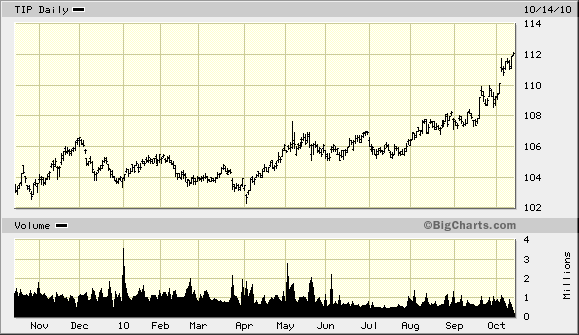
continued rally in TIPS (inflation protected bonds) in anticipation of higher inflation in the longer term

other charts below: TIP (tips etf), FIVZ (intermediate term treasury etf),edv 25+ yr treasury etf

EDV 25+ Yr Tresury etf
FIVZ 5-7 Year Treasury ETF


TIP Inflation Protected Bond ETF


Thursday, September 30, 2010

Active Bond Fund Investors Beware :Your Fund May Be More Risky Than You Think

 That actively managed bond fund you own may be more risky than you think The wsj reports

my bolds my comments in blue


How Safe Is Your Bond Fund?

A Change in How Portfolios Are Rated Gives More Weight to Risky Holdings


[BONDS]
Your bond fund may be riskier than you think.
For years, the fund industry and research firms such as Morningstar Inc. have assessed the safety of bond funds by analyzing their holdings' underlying credit quality. Now, amid concerns that the measurement could understate the risk that the bonds will blow up, Morningstar has changed its methodology to count lower-rated bonds more heavily.
The move—which took effect Sept. 1—means that more than half of the domestic taxable bond funds tracked by Morningstar saw their so-called average credit-quality ratings fall under the new methodology.
In some cases, people who thought they were investing in an investment-grade bond fund may find themselves in a portfolio whose credit risk is more like a junk-bond fund, says John Rekenthaler, Morningstar's vice president of research.
About 43% of bond funds fell by one credit grade and about 13% dropped by two credit grades, according to Morningstar. A few funds—including Federated Real Return Bond Fund, Cavanal Hill Intermediate Bond Fund, Neuberger Berman Short Duration Bond Fund and TCW Short Term Bond Fund—dropped by more, in some cases to non-investment-grade ratings, such as BB, from investment-grade ratings, such as AA. (See table.)

Of course it's the lower credit quality of the assets not the manager's skill that likely accounted for the higher returns of thse funds compared to those short term bond funds that held higher qusality assets such as a short term treasury fund.. That has worked well recently as credit spreads ahve narrowed. But of course when a crisis hits the lower credit quality bonds will suffer. And given that many investors view short duration bond funds as the stable core of their portfolio...that could lead to some unpleasant surprises.


 ....the percentage of domestic taxable bond funds that had average credit ratings of "AA"—or investment-grade status—fell to 13.85% under the new methodology from 36.38%. Funds with average credit ratings of "BB"—or junk-bond status—more than doubled to 13.36% under the new system from 5.49%. "If the credit rating moved down more than one notch, I'd look closely in making sure you understand the strategy of the fund," says Morningstar's Mr. Rekenthaler. "If it only moved down a notch, I wouldn't worry about it at all."
Bond funds that invest mainly in corporate bonds and private mortgages were generally the most affected, he says. Funds that employ a "barbell" investing strategy—investing in extremely safe investments at one end and higher-risk investments at the other—also tended to see big drops in their average credit-quality ratings.

I doubt many individuals investors have the time or the skill to drill down on the strategy of their active bond fund manager and even if they did the data they would be using would be quarterly in arrears so it would not give a real time view of the fund holdings and strategy.

My solution: invest in a bond index fund or etf you will have total transparency and know exactly the characteristics of your portfolio in terms of duration, maturity, and credit quality.

Wednesday, September 29, 2010

Active Equity Fund Investors Beware The End of Quarter Window Dressing !

Just caught an analyst explaining how the end of the quarter always features active mutual fund managers engaging in "window dressing". What does that mean ? These managers increase their holdings in stocks that have best performed during the quarter. "Even though they haven't owned the stocks during the period when they went up" the CNBC reporter noted "correct" responded the money manager being interviewed.

In other, words that quarterly report from the active fund manager listing his holdings tells you nothing about what he held over the course of the quarter. And you really never know what the fund owns,

Of course non of the above holds for index funds and etfs Although the index fund investors will doubtless benefit from the window dressing particularly a shift from cash to equities. That only holds forever for investors that are not engaging to activity simiilar to the window dressing by purchasing what has gone up in the previous quarter.

Wednesday, September 22, 2010

About Those Performance Chasing Individul Investors Moving from Stocks to Bonds...

Here are total  returns for three months through yesterday:

 3 Months

Total Bond Index etf (AGG) 2.7%
Total Stock Index (VTI) 4.6%
Emerging Mkts (EEM) 10.1%
Small Cap Value (VBR) 3.2%
SP 500 (SPY) 9.2%


 12 Months (chart below)

Total Bond Index etf (AGG) 7.9%
Total Stock Index (VTI) 9.7%
Emerging Mkts (EEM) 14.3%
Small Cap Value (VBR) 10.4%
SP 500 (SPY) 9.2%


Tuesday, September 21, 2010

Think You Know What You Own When You Own An Actively Managed Bond Fund ? Think Again

Bonds form an important part of one's asset allocation. That allocation can include bonds of varying credit quality and maturity. But it is important to know the composition of one's bond allocation with regard to these characteristics. The best way to do this is to purchase bond etfs which are designated to match the characteristics of a particular bond index.

Yet many bond investors purchase actively managed bond funds often it seems engaging in performance chasing. Yet because these funds can often engage in purchases any time of bonds and sometimes can even short bonds, invest in credit derivatives or even hold equities the investor never knows exactly what he owns, As a consequence he never knows the risk parameters of his portfolio . Rather than having his bond holding as a stable counterweight to his equity holdings the investor is simply betting on the skill of the fund manager. In addition to the equity risk and fixed income market risk in a portfolio composed of bond and stock index instruments the holder of actively managed "go anywhere' bond funds has added "manager risk".

Today's wsj gives evidence (my bolds and comments in blue)

After rushing to the safety of Treasurys this year, Bill Gross of bond-fund company Pacific Investment Management, or Pimco, and Jeffrey Gundlach of DoubleLine Capital in recent months have pared back their holdings of U.S. government debt.

 This one is particularly shocking that bond alliocation in your protfolio which is invested in a major actively traded bond fund might actually be short treasury bonds:

Meanwhile, for the first time ever, fund firm Dodge & Cox is shorting Treasurys futures in some of its bond portfolios, betting they will fall in value, mainly as a way to manage interest-rate risk, said Daniel Culloton, associate director of fund analysis at research firm Morningstar. Dodge & Cox declined to comment.

If you are invested in the world's largest bond fund it would be difficult for you to know where your bond exposure is since it changes so drastically

In Pimco Total Return Fund, the world's biggest bond portfolio with about $248 billion in assets, U.S. government-related holdings fell to 36% at the end of August from 63% in June, according to Pimco's website. The holdings include Treasurys, Treasury inflation-protected securities and agency securities, among other things. A Pimco spokesman declined to comment.

The same would be the case for holders of the fund of one of the mutual fund world's "hot" bond fund managers:


DoubleLine's chief executive and co-founder, Mr. Gundlach, who predicted in June that the 10-year Treasury yield would fall to 2.5% or lower, reduced his positions in government-backed securities in DoubleLine Core Fixed Income Fund to 36% in August from 52% in July. The changes weren't prompted by a bearish view on Treasurys, Mr. Gundlach told investors in a conference call last week, as much as by the alternative opportunities available.

and if you hold the core bond fund from another fund company you now own a health chunk of non US bonds:

Meanwhile, managers of the Loomis Sayles Bond Fund, which is up 7.7% year to date through August, have been buying longer-term, investment-grade corporate bonds, as well as bonds from other countries, such as Canada, which the team believes to be in better fiscal shape and will benefit from growth in emerging markets, said Matt Eagan, one of the portfolio managers of the fund.
It seems pretty clear that holding actively traded bond funds to a portfolio can add plenty of extra risks there is only one sure way to avoid this: own exchanged traded funds tied to an index that are tied to a particular sector of the market. That is the only way to clearly know at all times the composition of one's bond holdings in terms of duration, issuer, and credit quality.

I caught a commentator on the morningstar website who observed that while there is a trend of funds flowing out of actively managed equity funds into etfs but no such trend in fixed income indicating perhaps that investors feel that active management works better in fixed income than in equities. Perhaps what s actually happening is that investors are chasing performance. Their money is flowing to actively managed funds with high returns,. And we know that the actively managed bond funds with the highest returns have been those that have been rewarded for taking the biggest risks in terms of long duration and high credit risk.

So far the strategy has paid off. But do the investors know the risks inside those actively managed bond portfolios ?

And how many of those managers will be as skillful in a bear market for bonds as they were in this great bull market ?


How many active bond fund investors will find out that they were "fooled by randomness" after all everyone is a genius in a bull market.