Sunday, May 29, 2016
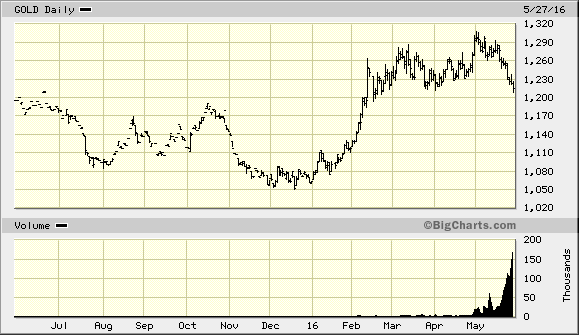
Update on the "Sure Thing" Long Gold Trade
Down a bit less than 8% in May and approaching what technicials call a "major support level" at $1200 according to technical analysis which imo is not mumbo jumbo espectially in commodites, a close below that would be deemed very negative. You can also see the spike in volume in late May. large scale selling just as the market turns is often as a sign some of those late to the party" taking losses.


Friday, May 20, 2016
More Pain for the "Smart Money" a Turnaround in Gold
In my March 16 entry I noted that two major "smart money" trades:
short US $ betting on a dollar fall
Short oil betting on lower oil
and that subsequent market moves turned those smart money trades into losers.
I noted the latest "smart money " trade was Gold...here's what we have seen very recently :
Bloomberg:
Gold is heading for the longest run of weekly losses this year because of the Federal Reserve
While the metal was little changed on Friday, it was set for a third weekly drop. Traders have boosted bets that U.S. policy makers will raise interest rates in the next few months, spurred by comments from Fed officials, minutes of the last policy meeting and quickening inflation.
Gold rallied to a 15-month high earlier this month on expectations that the Fed would keep rates lower for longer amid risks to the global economy, adding to the appeal of owning non-interest-bearing assets. As the likelihood of a rate move increased, the dollar strengthened, cutting demand for gold as an alternative asset.
The chart below shows more bad news for the smart money trade betting on a weaker US dollar as well as recent pain for smart money holders of long gold positions
The chart is entitled "different paths" but in fact the path is the same..a reversal of positions held by a large number of smart money" traders and a reversal as the Federal Reserve indicates a higher likelihood of interest rate changes.

Thursday, May 19, 2016
Update on Israelis Shekel(NIS) and US $ Exchange Rate and the Israeli Stock Market
NIS/US $ Exchange Rate
The NIS/US$ rate as reversed sharply of late with the US $ rising to over 3.8700 in trading on May 20 a 2 month high (chart reflects trading through May 19)

The reasons for the rise are related to two developments:
A weak GDP report for 2Q 2016 for with growth of only .8% (vs.2% the previous quarter) with a 4% fall in exports wasreleased eralier in the week. That would indicate no likelihood of rate hikes and also an interest to keep the NIS weak to help exports. Looking at technical analysis the break on the US $ downside accelerated after the rate fell below 3.8500 and accelerated in the other direction when it crossed 3.8500 indicating strong support/resistance at that level.
The second factor is the release of the minutes from the US Federal Reserve yesterday that increased the likelihood of US interest rate hikes in June. That would be a positive factor for the US $ as interest rate differentials would widen both vs the NIS and the Euro. As can see below Euro weakness has accelerated since the report and the sharp move likely indicating a reversal of many short $ long Euro positions.

Israeli Stock Market : Capitalization Woes
I have written before about the domination of the major Israeli stock index the TA 25 by the drug sector approaching 25% of the index. Not only does this mean the index is not diversified it also means that investing in the TA 25 doesnt reflect the economy and despite Israel's reputation as a high tech leader most top tech successes from Israel either go public on the US stock exchange --recent examples would be WIX and Mobileye or are sold to large global players such as WAZE being sold to Google.Investing in the index also doesnt give exposure to a broad range of Israeli domestically oriented coutntries and among those it has a high exposure to the large banks which make up another quarter of the index ..and have had poor results as of late.
Israel’s main stock index has drugmakers to blame for dragging the gauge to within 1.1 percent of a bear market.
Pharmaceutical companies Perrigo Co., Teva Pharmaceutical Industries Ltd., Mylan NV and OPKO Health Inc., which make up about a quarter of the TA-25 Index, have tumbled this year, wiping $27 billion off values and sending the gauge down 19 percent from a peak in August. The measure is near a bear market even though 76 percent of its members traded above their 100-day moving average this week.
Until the stock exchange limits a company’s weighting on the index, drug companies will continue to drive the stock measure lower, according to Ayalon Group Ltd.
“The weighting of pharma companies in the main index has been a problem as it’s not a reflection of the Israeli economy with most of them not even based in the country,” Yaniv Pagot, the head of strategy at Ayalon Group, an institutional investor in Ramat Gan, Israel, said by phone. “The bourse’s reform is clearly essential but coming a bit late. The bottom line is investors won’t be able to recover losses and as a result they may need to sell positions at an increased loss.”

Wednesday, May 18, 2016
401k Fees are Falling...Are Yours ? Some Tips on Your 401k in a Lower Cost Environment
The WSJ reports some good news for 401k investors:
401(k) Fees, Already Low, Are Heading Lower
Employers, advisers shave retirement-plan costs as they face pressure to monitor expenses
On average, the fees 401(k) participants pay for funds that invest in stocks fell from 0.77% of assets in 2000 to 0.74% in 2009, before dropping sharply to 0.54% in 2014, according to ICI, a mutual-fund-industry trade group. Fee reductions have also accelerated on bond funds and a hybrid category that includes popular all-in-one target-date funds.
Companies are lowering fees through various channels. More than 60% of 144 large employers said they were very or somewhat likely to move money this year into less-expensive share classes of the mutual funds on their plan menus, according to a survey Callan published in January. One-third of the respondents said they planned to renegotiate administrative fees. And 14% said they would switch some or all of their investment options from actively managed funds to index funds, which generally cost less.
These are positive developments of course and if your 401k plan still has high fees you should consider contacting those responsible within your corporation. Int the current environment of more regulatory scrutiny --and large class action suits against corporations with high fee 401ks-- your complaints may well elicit changes.
You should make every effort to understand all the fees in your 401k plan both administrative charges and the management fees of the funds available.
But even if the fees have come down and there are index fund options there are still other issues to consider to make the best use of your 401k particularly when you have assets in other accounts such as IRAs and taxable accounts.
- Just because it is an index fund doesn't mean it is low cost: The growth of index funds and ETFs has meant a race tot he bottom in management fees..with funds and ETFs in many stock and bond categories reaching below .10%. For example the Vanguard Total Stock Market Index Fund carries a management fee of just .05%.
But it is not at all uncommon to find 401k plans with index funds carrying management fees
that are far higher. There is no justification for a plan to include a total stock market index or S+P 500 index fund with a fee of .50% but that is not uncommon. Including ad S+P 500 index fund and justifying a .50% fee because it is significantly less than the actively managed funds in the plan is likely to raise issues in terms of the fiduciary standard .
- In what asset classes are index funds available ? It is quite common for a broad capitalization weighted US stock market index fund based on the total stock market index or an S+P 500 index fund to be available.
- But a diversified portfolio should include small cap stocks. Yet small cap stocks have a very low weighting in total stock market index and no representation in a S+P 500 index.
- A diversified portfolio should also include international stocks so a 401k plan should offer choices in international equities as well.
- And a broad range of choices among bond index funds should allow a mix of short and long term bonds, government and corporate rather than just a single bond index fund.
Beware the target date funds: Many 401k plans now offer target date funds and some may even have the target date fund as the default option. But target funds may not be a good choice. The funds set a balance between stocks and bonds based on age/expected date of retirement and then adjusts the mix of stocks and bonds reducing the stock allocation and moving assets to bonds as retirement approaches--the glide path"
It is important that the investor understand the glide path and whether it fits with their plans. A spouse's age or retirement plans and what other assets are available for retirement are just two examples of factors that may mean the "glide path' of the target date fund is appropriate.
What is in the target date fund ?. There is an asset allocation within the target date fund it is important to know what is used for the stock and bond allocation: are they index funds or actively managed funds? international and domestic stock funds? what are the bond allocations.
All of the above would argue that many investors would be better off constructing their own allocation for their 401k rather than setting it on auto pilot with a target date fund/
Putting your portfolio together: Your 401k + your other investment accounts
The emergence of lower fees in 401k plans is definitely a positive environment.
Creating a comprehensive asset allocation involving your 401k and that of your spouse as well as other assets such as IRAs and taxable accounts is the best approach to meeting your investment goals.
Here are some tips:
Bonds go into tax deferred accounts: Because income in IRAs and 401ks are not taxed currently and interest income is taxed at ordinary income rates it makes sense for most investors to put their bond allocation in tax deferred accounts.
Optimize the use of index funds in your 401k . No 401k plan will include as wide a variety of index funds as are available in the index fund and ETF marketplace which you can access with your taxable or IRA accounts.
That means that you should use the index funds available in your 401k to implement parts of your asset allocation and your outside account when necessary to fully implement the asset allocation.
Create an Overall Asset Allocation not just an Allocation for the 401k
For example your overall allocation might call for a traditional capitalization weighted index as well as allocations to value or small capitalization stocks , developed international and emerging markets. But your 401k plan might not offer index funds in all those categories.
To implement the allocation 401k funds would be used to fill the capitalization weighted US stock index part of the allocation and the accounts outside of the 401k would be used to purchase ETFs in the other categories of the asset allocation.
It is also not uncommon for a couple to find that the 401k plans of each employer have different choices. One plan may include a small capitalization index fund which could be used to fill that part of the allocation while the other plan may only include an S+P 500 fund,
Rebalance: Investors tend to chase performance buying high and selling low..the opposite of what is done when one rebalances back to a target allocation. Many 401k plans offer autormatic rebalancing. But that rebalancing isnt done at the portfolio level taking into considerations all the investment accounts.
Consider Getting Assistance form An Outside Professional
The lower fee environment for 401ks and the changes in regulations on advice for rollovers from 401k plans to IRAs are a very positive development. But as can be seen above implementing the proper asset allocation strategy is still far from simple. There are various ways a professional advisor can help
Periodic consulting: If the vast majority of your assets are in your 401k all you may need is a consultation with a professional to personally review your situation and recommend an asset allocation . An annual review would likely be optimal as well. Investment professionals should be able to offer that service as well.
Comprehensive asset management: Some 401k plans allow investors to have an advisor manage their 401k plan. For investors that have a portfolio consisting of significant assets outside of the 401k plan it might be optimal for the investor to have an advisor manage all the assets therefore taking care of the asset allocation and rebalancing .
Asset Management + Consulting: In the cases where the investor cannot or does not want to have an advisor directly manage their 401k assets a hybrid approach may be best. The advisor would have direct management of the non 401k assets and then work with the investor on a consulting basis with regard to the 401k assets making sure there is an integrated asset allocation and rebalancing.
I work with clients in all these services with clients in person in the Southern California area and by skype/email throughout the US.
Monday, May 16, 2016
Emperors New Clothes' Time for Hedge Funds
The recently conclued SALT conference of hedge fund managers in Las Vegas this year has generated much press. It seems this year it was like a meeting at the Versailles Palace on the eve of the French Revolution It was a sharp contrast to the Berkshire Hathaway annual meeting where 1000s of individual investors gathered to hear common sense on investing from Warren Buffett and Charles Munger..including some sharp criticism of hedge funds and strong recommendations for investors to choose low cost index funds for their stock investing.
From the WSJ
Hedge Fund Star: We Are ‘Under Assault’
Leon Cooperman of Omega Advisors sums up the mood at the annual SALT conference in Las Vegas
LAS VEGAS—Some of the most famous minds in investing convened here this week for an annual celebration of the hedge-fund industry. But, feeling the weight of years of underperformance and an uptick in client defections, the mood was anything but festive.
Longtime hedge-fund manager Leon Cooperman openly questioned whether it made sense to continue on after redemptions from his firm, Omega Advisors.
Major hedge-fund clients, including China’s sovereign-wealth fund, aired doubts, positing that 90% of hedge-fund managers probably weren’t skilled enough to navigate the markets.
And it had been hard enough to get some of the attendees to even show up. The slump in the industry—highlighted by the largest exodus of investors since the financial crisis—damped interest in the SkyBridge Alternatives Conference, commonly known as SALT, according to Anthony Scaramucci, the event’s organizer and founder of SkyBridge Capital, which puts $13 billion into hedge funds.
“There is a decided pessimism in the hedge-fund community,” he said, while predicting the industry would survive. “A lot of guys opted out of coming, frankly, because of performance issues.”...The mood was a far cry from previous years. since the start of the bull-market run in early 2009, a more traditional mix of stocks and bonds bested a broad hedge-fund index in 22 of 28 quarters, according to a Wall Street Journal analysis of data from research firms HFR Inc. and Morningstar Inc
It sees the conference organizers didnt quite have their story straight on attendance..not too good a sign about how they do on reporting fund manager performance:
A SkyBridge spokeswoman later said 2,100 people registered for the conference, up from 1,800 the year before.
You can find comprehensive reporting on hedge fund performance here
What Do Hedge Funds Really Do ?
One thing that is certain is that hedge funds dont do much hedging. They also dont necessarily have very unique investment strageies.
One widespread strategy is called merger arbitrage NYT:
The information about these transactions is public (or "curiously" all the arbs seem to know the terms of mergers yet to be announced)..meaning that all the hedge funds using this strategy pile into the same trades.
Lately many proposed mergers have not come through leaving much blood on the streets where hedge fund managers reside. Nothing very unique in manager skill in this strategy so it shold not be surprising that when the deals fall about the "top perfroming managers" have turned into dismal performanc. Among major deals that have fallen through recently due to regulatory or court rulings or just market forces have included Office Depot/Staples, Allegran and Pfizer (that deal alone was valued over $150 billion), Halliburton and Baker Hughes and Energy Transfer and Williams Company. The total value of these broken deals involving was well over half a trillion dollars.
While last year set a record for the amount of money spent on corporate mergers — $4.7 trillion — this year is so far setting a very different record: the dollar amount of deals that have come undone....Broken deals have whipsawed hedge funds that focus on merger arbitrage, a type of trading that places bets on the likelihood that deals will be completed. As one “arb,” as traders in merger arbitrage are known, described the current mood of the industry: Every day is like showing up unsure of whether to wear a helmet or a diaper.
“You’re definitely seeing a hangover from the M.&A. party from 2015,” said Aly El Hamamsy, a partner in Cadwalader, Wickersham & Taft’s mergers-and-acquisitions group, which occasionally advises arbs. “Things will stay interesting for a few months at least.”
Anxiety is higher than many arbs say they have experienced in years. Merger arbitrage was the worst-performing investment strategy in April
And it seems hedge funds using the merger arbitrage strategy are now loking at ways to hedge their risk by actually doing more research before jumping into trades:
Taking a cue from these troubled deals, some investment funds that do merger arbitrage trading are working with lawyers to pore over agreements to make sure they are placing trades on deals that are not likely to come apart.
Macro strategies
Another strategy that has performed poorly of late has been "global macro" which involves trading based on forecasts of global economic events. It shouldnt be much surprise that the world is more complicated and difficult than it seems and exceedingly difficult to forecast. Reversals in trends in oil prices and the dollar among other developments caused losses for these funds. the hedge funds research institute index of macro strategy hedge funds shows a 5 year return of .23% vs 4.7% for the total world stock index and 10.9% for the S+P 500
Hedge Fund Managers turn out to be not much different than other investors.
Despite their reputation for being sophisticated n their research and investing it turns out that hedge fund managers behave pretty much like everyone else showing all the pitfalls n their strategies. They tend to pile into the same trades as others, often simply because it has become a "hot trade" and then show reluctance to adjust to new information that challenges their assumptions. Since the hedge funds take large often leveraged positions when things go bad and they all attempt to reduce the trade at the same time prices drop sharply, liquidity dries up and the losses mount.
The poster child for this scenario has been Valeant. Bill Ackman considered one of the hedge fund geniuses took a huge position in this company. At an annual event open to all willing to make the appropriate charitable contribution (or following the news reports and gossip afterwards) Ackman joined other top managers in pitching their single best idea. Ackman's pitch : Allegran.
Apparenly other investors didnt do much more research other than listen to Ackman's speech and followed Ackman into thte trade. As the NYT reported:
Not coincidentally, big names like Paulson & Company, Viking Global Investors and Brahman Capital have also lost billions, collectively, by betting on Valeant — underscoring a growing phenomenon of hedge fund groupthink. It is a reflection of big-dollar investors chasing too few ideas and getting tripped up when things turn poorly for a company they have set big markers on.
“The bottom line is, hedge fund herding is not going away anytime soon,” said Andrew Karolyi, a professor of finance at Cornell University. “If anything, we are now seeing the early signs that this type of hedge fund herding is spilling over into herding of large institutional investors. To the extent that that spillover grows and expands, then we will be concerned.”
Hedge funds piled into Valeant as the stock soared more than $200 a share last year, even as warning signs about the company’s leadership and business practices began to appear. The stock is now trading around $36 a share, as Valeant prepares to install a new chief executive and races to meet a deadline to file a delayed financial report.
Despite their teams of "highly skilled" and highly paid analysts it seems the hedge funds cut lots of corners follwing the herd (much like the least successful of individual investors.Another exampe is Sun Energy touted by another "top hedge fund manager" David Einhorn at another conference in October 2014 when the stock was trading in the mid teens....the company declared bankruptcy and its stock is now trading at 17 centrs. Other top ranked hedge funds including Greenlight Capial, Glennview Capital and Omega Advisors piled in. Omega Advisors run by long time hedge fund star Leon Cooperman recenly told the SALT conference the industry is "under attack" and mulled leaving the industry in te wake of large redemptions from his fund.
How could this happen ? It seems these top hedge fund managers managing billions of dollars and receiving fees that make them among the highest paid and wealthies people in the world behave much like individual investors trading investment ideas at a cocktail party:
That so many hedge funds remained bullish on Valeant despite months of turmoil — as questions were raised repeatedly about its accounting practices — reflects the difficulty managers sometimes have with changing course.
“We all get lazy and when an idea seems to be working — inertia tends to take over and you stop paying attention,” said James Chanos, the founder of Kynikos Associates and one of Wall Street’s best-known bearish investors. “That’s on full evidence with Valeant and SunEdison too,” he added"
With this track record it is not surprising that institutional investors are rethinking their hedge fund investments discovering that the emperor indeed wears no clothes. A combination of simple index funds and ETFs including those that easily and inexpensively access alternative weighting strategies such as value and momentum...strategies which actually would often profit from the foibles of the "genius" hedge fund managers.
The head of China's investment Company had some pretty harsh words for the hedge fund industry on their investment strategy both generally and with regard to investing in her home country. Leading to a shouting match among some of the wealthiest men (yes the rest were all men) in the world.
Hedge Fund Managers Ditch Decorum in Shouting Match Over China (bloomberg)
China Investment Corp.’s Roslyn Zhang and others found themselves on the defensive on Wednesday’s panel. The CIC executive said hedge fund managers, many of whom have never been to China, were succumbing to a “herd mentality” in betting against the yuan.
“They really don’t know much about China but they just spend two seconds and put on the trade,” she said. “Should we pay 2 and 20 for treatment like this?” she said, referring to industry fees, traditionally 2 percent of assets and 20 percent of profits.
On the performance and skill of hedge funds the Chinese official pulled new punches in pointing out that the Kings of Finance may be not nearly as skillful as their reputations suggest: WSJ
China Wealth Fund ‘Disappointed’ in Hedge Funds
One of the biggest backers of hedge funds is having second thoughts.
“I have to say, the past few years I’m sort of disappointed with the performance, to say the least, of the industry,” Roslyn Zhang, managing director overseeing hedge funds for China Investment Corp., said at the hedge-fund industry’s annual SALT conference. CIC is the sovereign wealth fund for the world’s most populous nation.
The CIC official later told The Wall Street Journal in an interview that she was booting managers from her approved list and beginning the process of evaluating whether to slash the fund’s investment in hedge funds overall.
That amounts to a rather terse rebuke of the industry at this usually-buttoned up annual confab. China’s sovereign-wealth fund is one of the world’s biggest investors in hedge funds; it has more-than $20 billion in its “absolute return” investment category, which includes hedge funds, according to its annual report.
Much of the hedge-fund industry’s growth and hefty paydays in recent years have been thanks to a constant spigot of new money from deep-pocketed investors like Ms. Zhang.
“Many people blame Chinese retail investors [for a] herd mentality, but I see the herd mentality among hedge-fund managers now almost everyday,” she said.
Hedge fund managers much as is the case of individual investors may very much reside in Lake Wobegon where everyone is above average
She sad she was looking for more “skillful” partners to navigate markets than she had found so far among hedge funds.
“My experience with the hedge-fund industry is probably only 10% of managers are capable of adapting to the new reality. But I’m sure 90 percent of hedge-fund managers think they are the 10%.”
Individual investors investing in hedge funds usually invest in "funds of funds" adding fees on top of the fees paid to the hedge fund managers. They seldom if ever pay less than "2+20" fee structure(2% of assets under management+20% of profits) sometimes even pay more while larger institutional investors at times can negotiate discounted fees. This of course drives investor performance even lower
Institutional investors often hire high priced consultants to choose funds and these consultants are prone to chasing performance by moving their clients in an out of hot funds.
With the poor performance of hedge funds and the availability of capital weighted and alternative weighted strategies for .20% or less not hard to understand why the hedge fund industry fees "under assault".
Update on the Forecasts of the "Smart Money"
Oil:
Bloomberg May 16
Goldman Surprised by Sudden Oil-Market Turn as Glut Vanishes
Goldman cut its crude price forecast for the first quarter of 2017 to $45 a barrel from $55 previously, but sees oil rising to $60 by the end of that year. The bank expects global oil demand to grow by 1.4 million barrels a day in 2016, versus 1.2 million predicted earlier
 |
| Crude Oil One Year |
Currencies
Is the sun setting on the dollar rally?
Dollar Jump Catches Traders Short in One More Currency Calamity
Just when investors thought they’d finally made a good call in the currency market, the dollar’s advance messed it up.
The U.S. currency on Friday capped its best week all year versus its major peers, shortly after hedge funds finally switched to betting on dollar declines, known as going short. That’s not the only wrong move foreign-exchange managers have made this year -- an index tracking their returns shows they’ve failed to turn a profit in 2016.
 |
| Add caption |
 |
| US DOLLAR INDEX YTD
Where is the "smart money" placing its money now ?
Gold is the best-performing major metal this year after silver amid rising concern over negative rates in Europe and Japan and whether the Federal Reserve will be able to tighten further. Demand jumped to the second-highest level ever in the first quarter, according to the World Gold Council, and billionaire hedge fund manager Paul Singer has said gold’s rally may just be beginning. Investors are being driven to gold on a structural shift in investment demand, according to Bernard Aw, a strategist at IG Asia Pte.
The great gold rush of 2016 is gathering pace. Holdings in exchange-traded funds have now surged by a quarter, with investors taking advantage of lower prices over the past two weeks to enlarge stakes on rising concern about central bank policy making worldwide
Based on the performance of the "smart money" trades in currencies and oil...let's say some skepticism would be warranted.
Gold one year:
|
Wednesday, May 11, 2016
More on Hedge Funds...Wait Till Next Year...While We Collect the Fees
bloomberg
Rubenstein Says He’s Surprised Macro Hedge Funds ‘Got It Wrong’
Carlyle Group LP’s David Rubenstein said it was unexpected that so many hedge funds made wrong macro bets, leading to the industry’s worst start to a year since 2009.
“It does seem surprising that so many macro people got it wrong,” Rubenstein said Wednesday in an interview with Bloomberg Television’s Erik Schatzker. "But many of them will probably do pretty well in the future. I suspect when returns come back the industry will thrive again."
In aggregate, the $2.9 trillion hedge fund industry is having its worst start to a year in performance and investor withdrawals since global markets reeled from the most severe financial crisis since the Great Depression. Third Point, the hedge-fund firm founded by Dan Loeb, last month said the industry is in the first stage of a “washout” after a “catastrophic” performance this year.
Hedge funds lost 1.9 percent in the first quarter, according to Hedge Fund Research’s global index, the poorest performance since 2008. The industry had net outflows of $16.6 billion in the past two quarters, the most since 2009, according to HFR. In 2015, 979 funds closed, more than any year since 2009, according to the research firm.
Subscribe to:
Posts (Atom)