Search This Blog

Monday, February 16, 2015

German Stocks Hit an All Time High

Finally catching up to the US...and the performance chasers are joining in.And the valuation is still more than 20% below the US.

via bloomberg

(Bloomberg) -- German growth did the trick, sending the DAX Index inching above 11,000 for the first time.

A report showed Europe’s largest economy accelerated twice as fast as predicted in the latest event to propel German stocks 12 percent higher this year, while an exchange-traded fund tracking the nation’s shares drew record funds. Among developed markets, only Finland has performed better....
Germany, Russia’s biggest trade partner after China, was among nations suffering the most last year after Russia’s annexation of Crimea triggered European and U.S. sanctions. Investors pulled $1.1 billion from the iShares MSCI Germany ETF in 2014 amid concern the conflict with Russia will burden exporters.....

Friday, February 13, 2015

Lower Euro...Higher European Stocks

via Bloomberg


European stocks are rallying on speculation Mario Draghi’s policies will help improve economic growth, with a weaker euro boosting corporate profits.
The CHART OF THE DAY shows that the Euro Stoxx 50 Index and the region’s currency extended their moves in opposite directions, with the correlation between the two assets near an 11-year low. The equity gauge has rallied 8.6 percent this year as European Central Bank President Draghi announced a 1.1 trillion euro ($1.2 trillion) asset-purchase plan, pushing the euro down more than 5.5 percent.
Economists estimate the euro area will grow this year at the fastest pace since 2011, while export-reliant companies say they will benefit from the currency’s decline. Drugmaker Sanofi forecast the euro weakening may boost earnings as much as 5 percent. Carmaker Renault SA, which gets more than half of its sales from western Europe, jumped to a seven-year high after projecting higher deliveries and revenue in 2015.


As I have mentioned in several previous posts the growth of ETFs limked to the overall European and German stock market but hedged against a falling Euro allow one to profit from both of the trends in the graph below.

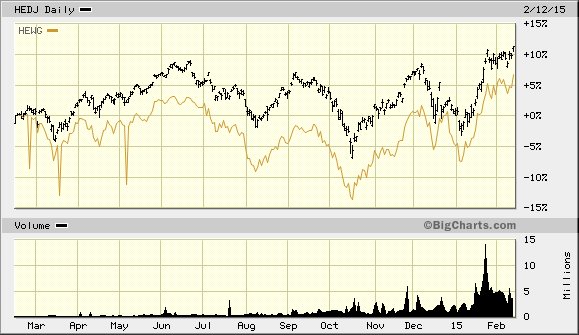
Here is a graph of HEWG the hedged Germany ETF and HEDJ the hedged Euro zone ETF
Below that is the Euro dollar exchange rate as can be seen the top chart matches the green line in the above chart and the lower chart the green line.


HEDJ currency hedged Europe (black) HEWG currency hedged Germany (brown)
US/Euro exchange rate


Thursday, February 12, 2015

Emerging Market Bonds No...Stocks Yes


I have written several times about the inadvisability of investing in emerging market bond funds. The yield pickup vs US $ bonds in my view doesn't offset the additional risk. Investing in emerging market bonds adds political and currency risk. Additionally, emerging market bond ETFs are concentrated in the emerging market countries with highest currency and country risk rather than a broad range of emerging market countries.
The strongest economies in the emerging markets are those countries that run current account surpluses and thus are not borrowers in the international bond market.So the countries with the strongest economies and equity markets are not accessed with bond ETFs. There is an additional disadvantage as well ,strong economic growth is often accompanied by higher interest rates/lower bond prices. So it is quite possible strong economic growth which would be good for stocks would be bad for bonds.

Bottom line.... if one is looking to gain exposure to emerging markets an investor is much better off holding an ETF of emerging market stocks vs bonds. This gives exposure to the strongest growing emerging market economies. The bond have similar currency risk and political risk as the equities but unlike the equities which have unlimited upside and downside potential the bonds have limited upside and unlimited downside potential (through default).

An example of the divergence between emerging markets stocks and bonds can be seen in recent developments.
From the WSJ

Emerging-Market Currencies Tumble as Worries Over Greece, Ukraine Escalate

Indonesia’s Rupiah Sinks as much as 1%, While South Africa’s Rand Hovers Close to Weakest in Over a Decade


Bond markets are also tumbling, sending yields surging and pointing to investors also pulling out of these markets. Yields move inversely to prices.
For investors, the weakness in Asia’s foreign-exchange markets, which have performed relatively well to their emerging market peers so far this year, is a surprise. As countries in Latin America and emerging Europe have grappled with domestic economic and political challenges, Asia has been resilient with signs of proactive new governments and central banks, and lower currency volatility.
Local currency bonds in Indonesia, Turkey, Thailand and the Philippines were top performers in 2014. Just weeks ago, yields on Indonesia’s bonds fell to multiyear lows as foreign investors poured into local government bond auctions.
But the currency’s sudden plunge Thursday had traders and dealers saying the central bank was intervening and had sold $50 million to $100 million.

The consequeences can be seen in year to date performance the broad emerging market stock ETF(ticker IEMG) ytd is +.9% while the local currency bond ETF (ticker EMLC) -3%

Growth of $100,00 IEMG(green) EMLC (blue)


The reason for the divergence as noted can be seen in the country allocation Below is the country allocation for IEMG the Emerging Market Stock ETF

20.65%

14.99%

13.38%

8.07%

7.74%

7.42%

4.46%

3.62%

3.08%

2.83%

2.65%

1.6%

1.46%

1.39%

1.36%

1.06%

3.92


And Here is the allocation by country and currency of EMLC the local currency emerging market
by % 


Poland  10.28
South Africa 911
Malaysia 9.09
Brazil      8.65
Mexico  8.02
Turkey  7.97
Indonesia 7.00
Colombia 6.69
Thailand   6.52

Hungary   4.76
    • C

Here are the Expert Forecasts on the Future Price of Oil

via Bloomberg It would be even more interesting to check if a single one of these experts predicted the 50% decline in 6 months we saw in 2014

These Experts Know Exactly Where Oil Prices Are Headed


So what’s going to happen next? Here’s a sampling of predictions from the last two weeks:
  • Oil will probably continue to decline to as low as $30 a barrel, said Gary Cohn, president of Goldman Sachs Group Inc. “We’re probably in the lower, longer view,” said Cohn, a former oil trader.
  • Oil has the potential to reach $200 per barrel from a lack of investment in new supply, warned OPEC’s Secretary General Abdell El-Badri. “If you don’t invest in oil and gas, you will see more than $200,” he said, without giving a time frame.
  • Shale oil will soon be needed to make up for production declines around the world,pushing U.S. prices to as high as $65 a barrel, the head of Astenbeck Capital Management wrote in a Feb. 2 letter obtained by Bloomberg News.
  • In a Bloomberg News survey of analysts and traders, 12 of 32 respondents predicted futures will decline through Feb. 13, while 10 forecast an increase.
  • “We don’t think we’ve seen the bottom yet,” said Giovanni Staunovo, a commodities analyst at UBS in Zurich.
  • “We are establishing a bottom,” said Bill O’Grady, chief market strategist at Confluence Investment Management in St. Louis, which oversees $2.4 billion. “In the long run, probably $60 is going to be your pivot point.” 
  • Oil could fall as low as $30 because supply surpluses won’t disappear overnight, said Barclays analyst Miswin Mahesh.
  • “The fundamental supply and demand does remind me of 1986 a bit, where we could go into a period in this decade of lower oil prices,” said BP CEO Bob Dudley. Prices may stay below $60 for as long as three years, he said. “It will be a long time before we see $100 again.”
  • Oil could fall to the $30 a barrel range, said Fumiya Kokubu, CEO of Tokyo-based Marubeni Corp. He said he doesn’t see much of a price rebound in the next two or three years.
  • The recent surge in oil prices is just a "head-fake," and oil as cheap as $20 a barrel may soon be on the way,  said Citigroup analyst Edward Morse. He sees afourth-quarter rebound to about $75
What’s an investor to think? In 2015, the average price is likely to be anywhere from $35 to $80, according to a Bloomberg Intelligence survey of 86 investment specialists. That’s a pretty big range.

Wednesday, February 11, 2015

Here We Go Again..."The Case for Active Management"....Not!


Hope springs eternal and the financial media and the Wall Street marketing machine always seem to come up with reasons why there are reasons to choose and actively managed mutual fund.


So the WSJ brought the latest version of this argument. Looking through the article one can see it boils down to "there are investment geniuses out there, you will be able to find them in advance and they will show great returns in the future". But I will go through parts of the article and give a more thorough critique,

 Furthermore if the author is looking to advisors as ts hose advocating active management one must ask the question "what exactly is the advisor doing ?". Ihe is simply running though past performance of active managers and choosing a portfolio made up of them ? If so he is using a methodology that has little if any chance of producing similar returns in the future. On the other hand a portfolio consisting of a mix of carefully selected ETFs can create a well diversified trasparent portfolio and in fact deal far better with some of the issues raised below than simply choosing a group of actively managed funds

Text from the article is in italics my comments in bold

There Are Still Some Scenarios Where the Hands-On Way Might Make More Sense


... many advisers still believe that at certain times, and for certain strategies, actively managed funds are superior to index funds. That is particularly true, they say, if the active fund has a good long-term track record and charges lower management fees than most of its peers.

Study after study has shown that past performance of active managers is a poor predictor of future performance. With management fees on many ETFs declining to virtually nothing…even a “low management fee” actively managed fund carries fees that are a multiple of the ETF fees. The Vanguard Total Stock Market ETF (ticker VTI) carries a management fee of .05%. Even a fund with an extremely low expense ratio of .50% (less than half the fees of the average actively managed fund) would be charging 10x the fee of the ETF.

Dividend Stocks

As yields have fallen, investors have flocked to dividend-paying stocks for income, and that has spurred rapid growth in dividend-focused ETFs. But to enhance their appeal, companies that sponsor such ETFs often design them with an easy-to-grasp mission—such as generating the highest yields or owning shares only of companies that consistently boost dividends.
Such ETFs often focus narrowly on certain sectors, such as economically sensitive or defensive stocks, ……says Todd Rosenbluth, director of ETF and mutual-fund research at S&P Capital IQ.., if market sentiment shifts away from the sector where an ETF is focused, that can hurt its overall performance. An active manager could limit the impact of such shifts by diversifying, Mr. Rosenbluth says

This is one of the “ you will find a genius active manager argument” one could easily argue that the active manager will make bad dexisions on shifting sectors. Furthermore there is much to question about the focus on dividends by investors both stock pickers, fund pickers and ETF investors. Many of these investors “searching for yield” have come to view dividend paying stocks as a substitute for bonds…they’re not.
2. If Markets Start Trading Sideways
Historically, active managers have lagged behind benchmarks during long, strong bull markets, when securities selection makes less of a difference. They tend to make up lost ground when markets level off or suffer corrections.
Could that signal better performance this year? The bull market may still have life left. But if stocks struggle and companies find earnings growth harder to come by, that is a climate that would favor active management, Mr. Reynolds says.
It seems at the beginning of every year we get the “this year will be a stockpickers market” prediction. First off I am not sure of the accuracy of the  assertion above particularly since correlation among stocks has increased. Also it is not clear how the data is constructed if the comparison is of the funds vs the S+P 500 it is not particularly valid since the S+P 500 is basically a large cap growth index so excludes value stocks large and small.
Additionally, even if the above argument were the case…how does one know in advance what the future direction of the market will be. The argument is a circular one..if you know the future direction of the market you will know when to move to an active manager…and of course you will pick the one that will outperform

3. When You Own Bonds
Bond yields move in the opposite direction of bond prices, so if rates are headed higher this year, it could be risky to own an ETF that closely tracks a broad bond index. Some types of bonds would be particularly hurt, including Treasurys and certain mortgage-backed securities.
One widely held bond ETF, iShares U.S. Core Aggregate Bond (AGG), has more than half of its portfolio in such rate-sensitive securities. …Moreover, such ETFs can’t change their portfolios to reflect concerns about rising rates, because they are obligated to replicate the performance of an index as closely as possible by owning securities in the index.

The above statement is correct but is not one of the negatives of bond ETFs but rather a positive. Since the ETFs have total transparency it is possible to build a bond allocation with ETFs and know exactly what one owns. There is no obligation to own only the total bond index (AGG) an investor could easily reduce the risk associated with rising rates by moving to short term bond ETFs. A good advisor should be able to reduce the interest rate risk in a bond portfolio through use of a mix of bond ETFs
Then we get the following argument for active bond management
 As a result, at times when rates might be headed higher, such as now, investors may be better off in an active fund with the flexibility to reduce interest-rate sensitivity….
Flexible funds also can reduce overall rate sensitivity through a range of derivatives transactions. And they can build cash positions and move to the sidelines when certain market sectors grow expensive, she adds.
“This is a time when active management can really show its value,” Ms. McDonough says.
Last year’s major event in the world of bond mutual funds with the fall of “bond king” Bill Gross and his Pimco Total Return bond fund showed exactly how such active management can produce dismal results and additional risk. Such managers take big risks based on their judgement of future bond market developments…sometimes they are right and sometimes they are wrong but the investor doesn’t even know in real time how the fund is positioned. Once again investor has taken a bet on a genius manager not a transparent bond strategy that could be easily implemented with low cost ETFs. Gross has moved on to another firm, assets have flowed massively out of  Pimco Total Return once the largest mutual fund in the world. There is a new hot “genius” fund manger whose fund has generated massive inflows and has so far had great success profiting from his bold bets on the bond market…how long that will last is of course impossible to know.


When Investing Abroad
ETFs make it easy to get non-U.S. exposure. But those based on market-cap-weighted indexes tilt toward the largest foreign markets, sometimes exposing investors to weaker economies, including, for now, Russia and Western Europe.
Actively managed international funds can fare better at diversifying away from indexes, says Jon Hale, director of manager research, North America, at Morningstar. For example, he says, they can boost returns by buying stocks in faster-growing emerging-markets nations that aren’t included in certain widely used foreign-stock benchmarks, such as the MSCI EAFE Index.

Part of the argument above makes absolutely no sense of course emerging markets aren’t include in the EAFE index..it’s a developed international index. Those looking to add emerging markets exposure to their portfolio would make their international holding a mix of low cost developed and emerging markets ETFs,
Choosing an active manger in emerging markets means picking a manager that will make the correct decisions as to country and individual stock selection…a tough task to achieve consistently. Even the article here shows how difficult the task is. The author lumps together Europe and Russia as “weak performing economies” by which I assume he means poor performing equity markets as well. Ironically the European stock ETF VGK has outperformed the S+P 500 this year 3.1$ vs. .6%,

Furthermore an advisor can easily make use of the vast number of ETFs to allocate a portfolio not only between developed and emerging markets but to specific companies or regions...and even hedge out currency risk. I have written previously of the case for overweighing Asian Emerging markets vs other countries in the emerging market category and of hedging the risk of a weaker Euro through currency hedged ETFs. Not only is this easily done it can be done in a fully transparent manner..unlike an active manager whose holdings are not available in real time.

5. If You’re Worried About Volatility
Limiting losses can help in building a nest egg. And some ETFs aim to provide downside cushion by focusing on lower-volatility stocks. ….But active managers have more ways to play defense, …They can own higher-quality stocks and trim positions as valuations rise. “They don’t have the pedal to the metal when the markets are going up, and they put the brake on more quickly when markets are going down,” says Mr. Clift.

Another one of the “there are geniuses and you will find them argument”. While low/minimum volatility ETFs have a short tracke record they are based on a methodology which can be back tested rigorously over decades…unlike an active fund managers strategy and of course few if any fund managers have performance data going back decades.
Most importantly…if you are worried about volatility…you should own less stocks and more short term bonds.

If this article shows anything about use of actively managed funds it is how weak the case for using them is Either by choosing a small number of broad assset class funds or using a mix of ETFs to target particular sectors of the bond and global equity markets the case for using the ETFs and passing on the actively managed funds is a very strong one.


.


Saturday, February 7, 2015

Value vs Growth Why Value Stocks Outperform

The data are overwhelming: value stocks beat growth stocks. And since it is well proven that active managers underperform passive/asset class investors, the superior choice seems clearly to be passive funds targeted towards value stocks.

This strategy has now been categorized as part of the "smart beta" trend but in fact it has been practiced by Dimensional Funds Advisors (DFA) in funds available only through advisors for more than two decades. There are also several ETFs with varying methodologies. Vanguards' carry the lowest expense ratios
VTV large cap
VOE mid cap
VBR small cap

Two etfs with a methodology developed by Research affiliates uses a different methodology but is value weighed
PRF large cap
PRFZ small/mid cap

A nice summary of the data on value vs growth is here with a table with data.
http://valuestockguide.com/stocks/smallcapvalue/

The explanation for small value vs growth performance is stated nicely:

  1. Small Cap Value stocks are generally very boring companies that no one has heard of. These are unglamorous companies, unlikely to garner much oohs and aahs around the dinner table
  2. Investors over react to growth prospects and bid up the shares high. That is why growth stocks are expensive and provide smaller returns. On the flip side, investors over react and force the smaller value stocks down at the slightest whiff of bad news or general discomfort.
  3. There is insufficient coverage of these stocks on the Wall Street due to smaller size and lack of liquidity. As a result, they escape the attention of most institutional and retail investors who depend on brokers or sell side analyst’s recommendations
  4. Most institutions and funds are not allowed to own small cap and micro cap stocks and if they do come into possession of any such stock, perhaps due to a spin off, they are forced to sell off their position
Due to these reasons, there is little investor interest in small cap stocks. But enterprising value investors know that small caps offer the best places to find true value stocks that will on average comfortably beat the market over the long term.

The article includes lomg term data but the last ten years shows the same patter small value total return of 127% VTI total stock market (which includes some small value stocks) 1118.9 %and the S+P 500 (all large cap with a higher weighting to growth than value 107.7%.
This also demonstrates that the S+P 500 is not a good representative of the entire market it is totally a large cap index weighted towards large cap growth.
So why not own only small value stocks ?: this group of stocks is significantly more volatile than the overall market and the outperformance is over the long term small value stocks can underperform for long periods. Not only is patience required it is also important to note that a period of significant underperformance if it is at a period close to when the investor is approaching retirement when hopefully the portfolio has grown significantly and can have a big impact without time to recover porfolio value when there is "reversion to the mean" and small value again outperforms.
Another good summary of the data is here...with some important advice

Profiting From Small Caps Comes From Patient Management

http://www.valuewalk.com/2014/06/small-caps-value/

Thursday, February 5, 2015

Should you use a Robo Advisor ? Part One: Why they Give Too Little to the clients


So called robo advisors where one uses a web based service to have one’s investment portfolio managed seem to be gaining traction. The largest of these Wealthfront has the backing of prestigious academics such as Burton Malkiel and $1.8 billion in assets under management. The other major player Betterment has extensive VC backing and says it already has $1 billion in assets under management with 60,000 customers. Some articles by advocates of these robo advisors say it will “crush” the business of independent investment advisors…like me.

I think it is great that investment advice is getting more accessible and everyone should have to justify the price they charge for their services and give fair value. But after giving Betterment and Wealthfront a test drive I have concluded that when more is needed in advice Betterment comes up short and when less Is needed they probably come up with too much.
I will explain what I mean in two posts.


Too little

The major problem with these Roboadvisors has actually nothing to do with the asset allocations it proposes but with the fact that those asset allocations are produced without getting to know the customer.

The asset allocation gets spit out based on a few questions: age,for what and when do you need the money, current assets, salary and a couple of “risk tolerance ‘ questions.
There are major problems with this in fact here are just a few

Since Betterment and Wealthfront (like the less thorough flesh and blood advisors) are only interested in the assets it can capture under management they never seek to gain a full financial picture of its client. Answer a short set of questions on the website click the mouse and you have an asset allocation”that meets you circumstances” ready for them to invest for you.

A good advisor would offer a consultation asking these along with many other questions. Only after that review could the advisor put together an investment strategy and in all likelihood in which the allocation of any assets to be directly managed by the advisor is actually one of the least important parts of the investment decisions.

Here are some basic questions robo advisors doesn’t ask:

  1. Family situation spouse’s salary and professional situation. Number and age of children.
  2. Other income besides salary or business income such as rental properties.
  3. Tax bracket and other relevant tax information.
  4. Whether the client and spouse are making maximum IRA contributions.
  5. Whether either or both of the heads of household works for a company with a 401k plan whether it has a company match (and how much) and what the balance is and how much is being contributed annually.
  6. How are the 401k assets invested and what are the investment choices.
  7. If the clients are self employed do they have a SEP IRA or individual 401k…and how would they determined if they should set one up.
  8. If they are saving for college does a 529 plan make sense, if so which plan should they choose and how should they allocated the investments.
  9. Does either of the clients have a pension
  10. What are the “savings goals” in all likelihood they include things other than retirement: purchase of a first or trade up or vacation home. College education, or starting a business would be some examples.


A good advisor would give a consultation and offer a full for fee consulting service on portfolio allocation even if it would not generate “assets under management” for an ongoing asset management fee.
A proper investment consultation would first of all make sure the investment strategy maximizes the potential for the best after tax returns. This is far more dependent on proper placement of assets and use of tax advantaged investment accounts than on the choice of asset allocation.

Here are the areas a thorough investment consultation should review:

Make sure the client’s first savings go into tax deferred accounts
IRAs or Roth (and explain the advantages of each)
For those with a 401k their first savings should go into the maximum contribution to the 401k plan most certainly the amount that generates the largest employer match.

Assistance with the asset allocation in the 401k or 401ks for a couple taking into account allocations in other accounts.

For the self employed review of the various tax deferred accounts available: individual 401k, Sep Ira and defined benefit plan and assistance with asset allocation.


It doesn’t ask basic questions such as about the spouses salary and occupation, whether the client has a 401k available to him, whether he is saving for more than one purpose (i.e. college and a new house and retirement), how many children in the family and what ages and whether either of the heads of household is self employed
For those saving for college review of the benefits of 529 plans assistance in choosing a plan and generating asset allocation.

Betterment spits out either a taxable account allocation which includes a national municipal bond ETF in the bond allocation or a tax deferred allocation which includes taxable bonds. But it never integrates the two and gives an allocation for the most common situation: someone with both a tax deferred account like a 401k and a taxable account.
 Without an integrated allocation the client will wind up with a tax inefficient allocation. To give the most basic example: as much as possible of the bond allocation of a portfolio should go into the tax deferred account to avoid current tax on the bonds same for instruments like REITs that generate current income. Stocks which will be held for the long term and subject to what in most cases are lower capital gains taxes should be placed in the taxble accounts.

In sum Betterment is “too simple” in simply producing an asset allocation for the assets the client intends to have Betterment manage without actually learning anything about the client.

The difference between the investment strategy based on a thorough knowledge of the clients financial situation and the one based on a simple questionnaire has far more consequence for the long term growth of a portfolio than the specific allocation and portfolio management which Betterment provides.

Even if one chooses Betterment to manage investment assets it would be money well spent to have an investment advisor provide a consultation to cover the issues above.

In my next post I will examine the “too complicated” part of Betterment’s service…the asset allocation.