Search This Blog

Tuesday, October 26, 2010

Still Think Your "Full Service" Broker is Objective When He Recommends Muttual Funds ?

from Financial Advisor Magazine my bolds and comment in blue
Brokers Flee Brokerages As Declining Assets Show Broken Model

...More than 7,300 brokers have left the four biggest full-service brokerages -- Morgan Stanley Smith Barney, Merrill Lynch, Wells Fargo Advisors and UBS Wealth Management Americas -- from the beginning of 2009 through June, according to financial services research firm Aite Group LLC in Boston and company filings.

Losing Assets

Some brokers have fled internal clashes from mergers during the financial crisis: Bank of America Corp. rescued Merrill Lynch four months before the Smith Barney deal. Others have been recruited by discounters such as Charles Schwab Corp. to join their networks of independent firms.....


While lacking the clout of big brokerages, independent firms boast of one advantage with clients: no conflicts of interest. Brokers at Merrill Lynch, for instance, are pressured to sell funds managed or approved by the firm because they pay a higher commission than those run by other companies, says Paul De Rosa, who worked at the brokerage for 26 years before co-founding his own firm, Gateway Advisory LLC, in Westfield, N.J., in January.

De Rosa set up Gateway Advisory as a registered investment advisor, which has a fiduciary duty to put its clients’ financial interest first when giving advice, according to U.S. Securities and Exchange Commission rules. RIA firms must also disclose conflicts. To avoid them, RIAs like Gateway typically shun commissions and charge a flat fee of less than 1% of assets under management regardless of the funds they recommend.


I do have one question however, why did it take this gentleman 26 years to figure out that there was a conflict of interest in the way his previous employer dealt with clients ? 


About GDP Weighting and Emerging Market Allocations in Portfolios

from today's FT

my bolds and comment in blue

Emerging nations: a beacon of opportunity

By Jerome Booth
Published: October 25 2010 19:19 | Last updated: October 25 2010 19:19
If you are looking for a market bubble do not look to emerging markets. The US and Europe remain a huge super-bubble. Emerging markets, by contrast, are safe. Putting one’s head in the sand and denying this reality has the attraction of plentiful company, but constitutes the opposite of prudence. Remember, lemmings also like to crowd together and the collective name for them is a “suicide”.
Unlike Europe and the US, emerging markets do not have a credit crunch, in essence a multi-year, very painful, deleveraging – that is, wealth destruction. But if you have not experienced 30 years of rising financial leverage, the past 10 to excess, you cannot get a credit crunch. Emerging markets are in a very different cycle to the developed world now, with inflationary not deflationary pressures....

although I have a preference for emerging markets equities over debt I share some of the reasoning here:


The size of the emerging debt market is thus driven by demand, which is growing in an iterative way because of behavioural constraints. I am a big believer in GDP weighting – cap-weighted indices of publicly listed securities (typically misnamed “investible”) are a very poor representation of global investment opportunities. A better measure of global economic activity – and hence the full universe of investment opportunities – is past income – GDP, and that implies 50 per cent allocations to emerging markets.
Also the largest problem in the institutional investment industry arguably is misaligned incentives, which causes massive herding. It is the combination of these two deficiencies, combined with prejudice about emerging markets and inexcusably deficient concepts of risk and uncertainty that lead to gradual allocation.
A pension fund manager told me recently: yes, he agreed that GDP weighting was sensible and he was massively underweight, and yes, the industry suffered from herding where everyone was watching their peers, but he still had to be in the herd, though he could be at the edge of the herd. The result is that institutional investors invest a fraction of what they think is appropriate in emerging debt until their peers catch up and the result is gradual allocation over a period of many years. This is currently happening with many different types of investor peer groups all over the globe. Hence we have a gradual structural shift, not a temporary reversible move.

If He Knows The Secrets Then Why Is He Writing Books and Talking on TV....

instead of managing money and collecting hefty fees for his money management ?

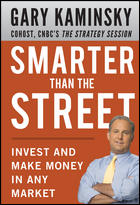
The folks at Dimensional Fund advisors long ago coined the word "financial pornography" for this sort of stuff. CNBC "fast money" guru and apparently ex money manager touting his new book and surefire strategy to beat the market and telling us why index funds are a fool's investment
you can catch it here. 
Among his criticisms of index funds: "if you invest in an index fund you just get the return of the index"...brilliant.


from the blurb for the book

Kaminsky brings more than two decades of experience to his low-risk, high-return system, demystifying Wall Street for novice and seasoned investors alike. Between 1999 and 2008, Kaminsky’s team at Neuberger Berman grew record-breaking returns far above the S&P benchmark. And they didn’t do it by magic. They did it by constructing a specificstrategy and sticking to it, regardless of the investing climate. It is a strategy that anyone can learn and apply, step-by-step, in any market.
With Kaminsky’s expert guidance, you’ll learn how to be more disciplined and vigilant with your investments, maximizing your returns in a minimum amount of time. You’ll not only make money in most markets, but you’ll lose much less money when those around you are losing their shirts. And you’ll be able to strengthen and protect your assets—particularly in the slow-growth decade ahead—with the confidence and know-how that drives Wall Street’s smartest investors to the top of their game.
Yes, you can beat the market—when you’re Smarter Than the Street.

Biographical note

Gary Kaminsky is the cohost of CNBC’s "The
Strategy Session" and has been one of Wall Street’s
savviest money managers for the last two decades.
He worked at Neuberger Berman, LLC, where Team
Kaminsky’s assets grew from $2 billion to $13
billion during Wall Street’s lost decade.

my ? why is this wasting his time guy wrtiting books and gabbing on tv everyday ?
And why is he willing to give away the secrets to make money in any market for only $26 ($17.16 at amazon, even less on your kindle). Seems to me that would be the mother of all bad trades.

Seems to me he should be either:

1.  managing one of the worlds largest hedge funds collecting massive fees
2. sitting on a yacht in the south of france living the good life
and/or
3. competing with the Gates foundation to give away as much money as possible to worthy causes

something's wrong with this picture

Sunday, October 24, 2010

Performance Chasing...Probably But If Not Investors May Be Making a Good Reallocation in their Portfolios


The latest mutual fund data on cash flows has been released and (surprise) they show investors,  both individual and institutional, are performance chasing pouring money into the highest performing sector emerging market stocks

from the wsj
Fund managers have regained risk appetite, but still lack conviction about positive momentum in U.S. stocks, according to survey results released Tuesday by Bank of America Merrill Lynch.
The survey found that asset manager risk tolerance jumped this month by the biggest margin since April 2009, with the proportion of fund managers "overweight" on stocks tripling to 27%, from just 10% in September. However, the drive for stocks is being driven by global emerging markets. Nearly half of asset managers are sitting heavy in emerging-market equities, according to the survey.
Among diversified global equity ETFs, which primarily invest worldwide equity securities but can include shares of U.S. companies, the Vanguard Emerging Markets Stock ETF has expanded the most. Inflows into the ETF have raised total assets by $15.7 billion, or 39%, this year. The iShares MSCI Emerging Markets Index Fund has taken in close to $4 billion, or 8.2%, in assets. Meanwhile, the SPDR S&P 500 ETF, a fund that mirrors the U.S. benchmark index, has shed $5.6 billion in funds, or 6.7% in assets.
The trend has to do with outperformance of non-U.S. stocks, but also is "a recognition of what came to light during the 2008 financial crisis, that the financial system in developed countries is not necessarily any better or less risky than in emerging markets," said Gregg Wolper, senior analyst at Morningstar. "Add in concerns with dollar weakness and it's reason to look elsewhere."
While investors may be engaging in a great deal of performance chasing here there may be some good rationales for these flows, provided they represent a long term change in asset allocation rather than simply a short term portfolio shift. US investors both institutional and individual have long showed a "home bias" keeping too much of their investments in US stocks. US stocks make up around 44% of world market capitalization so those investing in only US stocks are missing a measure of diversification. This is the case even taking into account that many of the largest US corporations generate much of their income from abroad.

But even making use of the standard indices for allocating assets outside of the US is likely not the best strategy. Those indices (and the etfs that track them) reflect the capitalization of world stock markets and thus are tilted sharply towards the developed market economies which have a high proportion of their firms listed on public equity markets. Those countries with the highest market capitalization get the highest weightings, while emerging markets whose equity capitalization is relatively smaller have low weightings. As world economic growth has shifted the world equity market capitalization less and less represents a measure of the world economy, a trend that is likely to continue.

An alternative approach to international allocation would be a GDP weighted index which sets the country allocation based on relative weight in the world economy. Such an index exists the MSCI GDP Weighted Index, although as of yet there is no etf or mutual fund based on it.  This is in a way analogous to the various times of "fundamental indexing" strategies that use methodologies based on critieria other than market capitalization in weighting their holdings

As MSCI writes

An Alternative to Market Capitalization Weighted Indices for Global Markets

The MSCI GDP Weighted Indices are designed to reflect the size of a country’s economy rather than the size of its equity market by using country weights based on a country’s gross domestic product (GDP).  Some investment professionals prefer to weight countries in a regional index by GDP rather than by market capitalization because:
  • GDP figures tend to be more stable over time compared to equity markets’ performance-related peaks and troughs
  • GDP weighted asset allocation tends to have higher exposure to countries with above average economic growth, such as emerging markets
  • GDP weighted indices may underweight countries with relatively high valuation, compared to market-cap weight indices.
Largest Absolute Weight Difference Between the Standard Market Capitalization Weighted MSCI ACWI and its GDP-Weighted Equivalent
CountryMarket-cap WeightedGDP WeightedWeight Difference(GDP-Market Cap)
China2.39%9.26%6.87%
Germany2.95%6.31%3.36%
Italy1.08%3.99%2.91%
Russia0.83%2.32%1.49%
Spain1.31%2.75%1.44%
India1.00%2.42%1.42%
Switzerland2.93%0.93%-2.01%
Canada4.57%2.52%-2.05%
United Kingdom8.11%4.10%-4.01%
United States44.39%26.76%-17.63%
Data as of June 1, 2009
The largest overweight countries in the MSCI ACWI GDP Weighted Index are classified as emerging markets, such as China, Brazil, India, Russia and Mexico, which are some of the fastest growing economies but have market capitalization weights that are smaller than their economic weights.
However, the list of over weighted countries also includes some developed markets, such as Germany and Italy.
The US and the UK have the largest disparity in size between their substantial market cap weights and their smaller economic weights.

Key Benefits
  • Alternative Approach to Capturing the Country Factor
  • Relevant Benchmark for GDP Weighted Asset Allocation
  • Broad Country Coverage


a research report from MSCI is here:
Thus there is in my view a strong argument for investors to increase their holdings in emerging markets based on the current composition of the world economy. In addition the following factors argue for such an increased relative weighting :

  1. Unlike during earlier boom periods for emerging markets, the growth in these countries is not funded primarrily with foreign borrowing.
  2. The growth of the middle class in these countries should fuel domestic demand and make these countries less dependent on exports to the developed world a trend likely to accelerate
  3. The demographic "bubble " in these countries is younger thus skewed to populations likely to increase spending and savings in the future. At the same time the demographic "bubble" in the developed world will be increasingly those withdrawing savings from public and private pension and retirement savings.
  4. The growth of the middle class will mean more savings and thus more funds to be allocated to local equity investments. Retail investing is at its infancy in much of the emerging markets.
  5. As these economies become more sophisticated more corporations will go public and the relative market capitalization of these countries will increase in world indices. Thus those that invest based on gdp weighting will be "ahead of the curve" relative to cap weighted international investors.
All of these trends mean that the future weighting of emerging markets on both a relative gdp and relative cap weighted basis will increase in the future. And all of this argues for a greater weighting in emerging markets than that dictated in a cap weighted index, greater than that in most US portfolios. There is certainly a strategic move being made by institutional investors worldwide into emerging markets which will help these markets. No doubt there is still the risk of hot money flowing in and out and there is not much to the argument of "decoupling" of the emerging market stock markets to the rest of the world, correlations are likely to remain high. But correlation does not mean there will be no outperformance, it simply means that both markets will move in the same direction at the same time.

Here is a chart of the correlation between the US total stock market (VTI) and emerging markets (EEM), over the past two years the correlation is very high.

  And here is a chart of the returns over the same period (emerging in blue). The two move in the same direction, but the difference in performance is enormous.


In both my client and personal portfolios my weighting for emerging markets in the international portion of their equity holdings is significantly larger than the 26.6% that is the weighting for emerging markets in the cap weighted world ex US etf (VEU). Making use of both the emerging markets index VWO and the emerging asia etf (GMF) the international allocation is tilted more towards emerging and more towards emerging asia than the VEU and for that matter more towards asia than the cap weighted VWO. I have kept to the allocation  except to rebalance to the target allocation.

If the investor flows into emerging markets represents a strategic reallocation of equity portfolios so that the portfolios have more international holdings and less of a home bias reflecting world market capitalization, world gdp weightings and/or trends for long term economic growth I would view it positively.

Unfortunately, based on our knowledge of investor behavior and of past flows in and out of emerging markets ,this data probably represents a large amount of hot money chasing performance. As is usually the case it will likely run the minute there is a selloff invariably buying high and selling low .

If there is good news in this it is that these flows can work to the advantage of the long term investor who rebalances to keep to his asset allocation. That investor can gain from the "rebalancing premium" when he sells a bit of his holdings to get back to the target allocation and buys back to get to the target allocation when the inevitable short term sellof pushes his holdings below the target allocation. Unlike the market chaser, the rebalancer is selling high and buying low. In fact the rebalancer actually picks up a bit in portfolio performance due to the volatility caused by the hot money (the rebalancing premium). It's not hard to envision that this has occurred numerous times in the volatile emerging markets where short term moves of 20% are not infrequent:


Friday, October 22, 2010

This Makes Sense to Me


from the NYT

A Basket of Assets in One Investment


AS investment vehicles, exchange-traded funds seem like a perfect fit for retirement portfolios.
The funds, known as E.T.F.’s, are generally relatively low cost and easy to understand. Listed and traded openly on exchanges, E.T.F.’s are baskets that invest in assets as various as global stocks and gold.
Yet picking the right E.T.F. is crucial. Far too many E.T.F.’s are overmarketed and some of the complex funds are loaded with nuances that most investors do not understand. E.T.F.’s can pose an almost irresistible, but risky, temptation to limit your bets to a single industry sector, country or commodity.
This is a particularly good time to invest in E.T.F.’s because major fund managers and vendors are battling one another to win customers by lowering costs. Brokerage commissions and internal fund management “expense ratios” are the major costs of owning E.T.F.’s. By taking advantage of this commission war, investors can increase the net returns on retirement funds....
With more than 1,000 funds to choose from in a $1 trillion industry, which E.T.F.’s do you add to your portfolio? You can start with the simple principle of diversification. Do you have funds that cover the entire United States stock and bond markets? How about international stocks and bonds?
It is also prudent to consider which risks you want to insulate your retirement portfolio from: market downturns, inflation, currency fluctuation and losing out on opportunities abroad, for example.....
Beware, too, of advisers who say they can beat the market with portfolios of E.T.F.’s.
Here I think the writer is oversimplifying a bit  or is at least unclear . No adviser should say he can beat the indices that are tied to the underlying etfs. Of course it is possible that a diversified portfolio  composed of etfs  tied to indices other than the s+p 500  such as the one recommended  in the article (see above in bold ). Could outperform (or underperform) the s=p 500 . And such a portfolio certainly offers more diversification and could  have a different risk/return profile. The  the s+p 500 which is a large cap US stock index in fact it doesnt represent  'the market" in fact it is not a very good proxy for the entire US stock market (unlike a total stock market index represented by an etf such as vanguard's VTI)
While you can always construct a portfolio on your own, it makes sense to consult a certified financial planner or registered investment adviser to see what your portfolio needs — and does not need — before you buy these vehicles. An investment policy statement outlining your objectives is essential. Duplicating what you already have makes no sense. (of course i agree with that one)

Structured Products for Individual Investors :Stay Away

In my earlier life on the institutional side of the financial world I specialized in marketing "structured products' to corporations and institutional investors. I can tell you that our department was extremely profitable. Why ? because the complex structure of these instruments made it difficult for most of the buyers to figure out what the underlying components of the product were hence the spread (markup) of the product were far larger than those of plain vanilla products. In structured products unlike those traded on exchanges there is no transparency of pricing. Furthermore it is near impossible to know the value of the structured product over the life of the instrument. There is also no liquidity in most cases as the investor cannot sell the option prior to expiration.

 To give one example a "structured product" which combined a floor on the loss on an investment but limited the upside potential was relatively easily constructed combining a put purchase and a sold call option. In fact the worst thing that could happen for our structured product group was when some of the structured products began to be traded on exchanges with transparency and liquidity for trading...why ? that meant the end of the massive profit opportunities. Of course most of these new markets were accesible only to large institutional investors.

With many of the profit opportunities no longer available in the relatively simple structured products, financial institutions moved on to market them to individual investors who do not have access to these institutional markets. Furthermore these structured products, unlike products traded on an exchange carry the credit risk of the issuer.

The NYT had an article on such structured products today my bolds and comments in blue


October 20, 2010
An Investment for the Experienced

By JOHN F. WASIK

DEPENDING on whom you talk to, structured products are either clever ways of hedging specific portfolio risks or another demon from Wall Street.
As vehicles that use derivatives to protect or enhance an underlying stock, bond or index, structured products are sold by nearly every major bank and brokerage house — and more than $34 billion of them were sold in the United States in 2009.
Yet they are not for investors who don’t fully understand them, because they are riddled with complexity, are mostly opaque and have lost money for investors in the past. 
“These are complicated investments, and people should know what they’re buying,” said Tom Balcom, a fee-only adviser with Ibis Wealth Management in Boca Raton, Fla. He said he had “yet to put more than 35 percent of a client’s portfolio in structured products,” adding, “If you don’t understand what these products are, stay away from them.”
Sean O’Toole, 43, who owns and operates an event-marketing agency in Fort Lauderdale, Fla., worked with Mr. Balcom to add structured products to his portfolio.
seems Mr. Balcom is ok with his clients buying structured products for less than 35% of their portfolios 
“I’m not betting the farm,” Mr. O’Toole said. “I like diversification. I’d rather be over-conservative if we see another double dip.”
An ultracautious investor concerned about the prospect of another huge stock market decline, Mr. O’Toole has two-thirds of his portfolio in cash and one-third managed by Ibis in structured products like buffered return enhanced notes, which put a cap on the potential gain in return for protection against a market decline. He pays no commission for the vehicles and a 1 percent annual asset management fee to Mr. Balcom.(of course the large markups on these products is not visible to the investor)
Before Mr. O’Toole bought structured products, he had experience with options strategies, an essential prerequisite for anyone interested in structured products.
He should have kept to those liquid transparent options imo. 
While structured products are not household names, they are hot sellers, and sales growth is estimated to be about 24 percent this year, according to structuredretailproducts.com, a service that monitors the industry.
Banks continue to market them aggressively as well. Structured note offerings are up 58 percent this year (through August), according to Bloomberg. The global market for these vehicles exceeds $1.6 trillion.
could that be because institutional investors burned in the past by these investments have been shying away ?After all it is much easier to sell a big structure note to an institutional investor (as in the good old days) then to sell large numbers of small ones to individuals. 
But the numerous disadvantages of structured products make them ill-suited for investors who want low-cost, government-guaranteed or liquid investments.
Once you invest your money, you are essentially locked in for the duration of the contract. Brokers may say they can buy them back, but often little or no secondary market exists for many of them. They may charge you another commission to do so and not guarantee the price you initially paid. Despite their many promises of principal or downside protection, investors can still lose money. Investors in principal-protected notes issued by Lehman Brothers, which filed for the largest bankruptcy in history on September 2008, found out the hard way that they held unsecured Lehman debt. Their principal was not protected, and most lost all of their investment.
Structured products have been linked to an estimated $1 billion in investor losses in the Lehman notes alone. UBS, the Swiss bank and brokerage firm, was one of the largest sellers of the notes and is being sued by investors and regulators in the United States and Britain...
Other structured investment vehicles like reverse convertibles and equity-linked notes are also the subjects of state investigations and investor lawsuits.
Don’t be cowed by the daunting calculus employed to hedge risk and produce returns. A competent adviser should be able to explain — and clearly illustrate — all risks (credit, market and liquidity), conflicts and expenses like commissions, underwriting fees, bid/ask spreads and embedded derivatives costs.....
If you don’t get a clear explanation or are uncomfortable tying up your assets in a virtually illiquid product, move on. These products don’t lend themselves to comparison and you can’t monitor them like you would a stock or mutual fund.
Most structured notes are “a hot mess,” said Janet Tavakoli, president of Tavakoli Structured Finance in Chicago and author of several books about them. “Most professionals can’t analyze them. When I have done it, I find these notes are loaded with hidden fees and hidden risks.”

Thursday, October 14, 2010

What Will Be the Bond Markets Reaction to Quantitative Easing ? Read the Message of the Market

It seems pretty clear that with both the fiscal and monetary stimulus have not put a dent in the unemployment rate While the public political debate has been filled with disappointment that the fiscal stimulus has not provided a cure to the high employment rate the Fed's actions haven't accomplished much towards that goal either. With more fiscal stimulus off the table it is clear the fed is searching around for what remains in its toolbox. Short term rates are essentially at zero, so it seems a near certainty the fed will move to quantitative easing = purchasing bonds to take intermediare rates lower. At the same time there seems to be the beginning of a campaign to indicate that a bit of inflation will be tolerated in an environment where the greatest risk is contnued  high employment.

A careful look at the bond market's recent movements give a clear indication of the consensus forecast:

fed intervention in the intermediate term of the yield curve will pull those rates lower (price higher)
long term inflation makes long term rates unattractive

hence the 30 year treasury spread over the 10 year treasury has moved to a record level of 1.4% , it was around 2.2 % a year ago ( a graph of the treasury yield curve is attached)

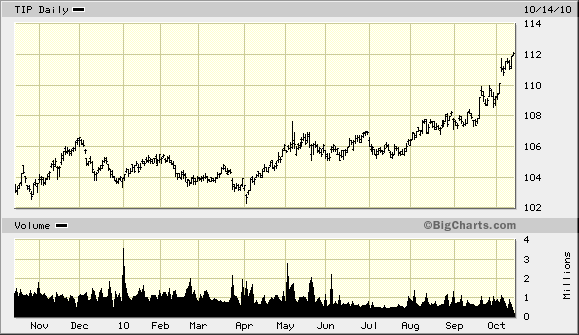
continued rally in TIPS (inflation protected bonds) in anticipation of higher inflation in the longer term

other charts below: TIP (tips etf), FIVZ (intermediate term treasury etf),edv 25+ yr treasury etf

EDV 25+ Yr Tresury etf
FIVZ 5-7 Year Treasury ETF


TIP Inflation Protected Bond ETF